

Education gave me the opportunity to write a different story
By Ashton Kline
Content note: This story touches on family violence, including the death of a family member. If this raises difficult feelings for you, support is available.
• 1800RESPECT: 1800 737 732
• Lifeline: 13 11 14
• Beyond Blue: 1300 224 636
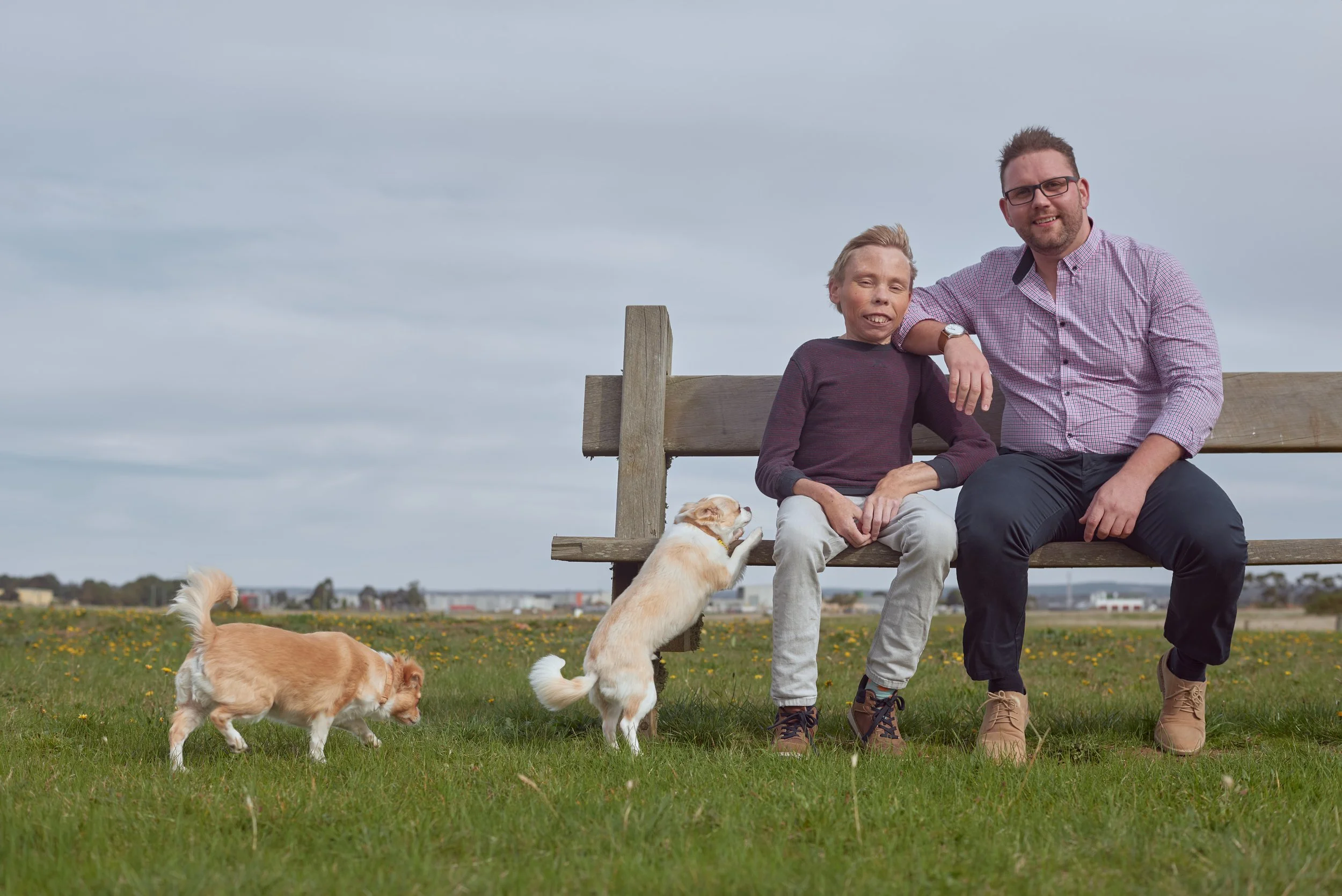
Ashton, Grant and doggos Lewi and Blaze
When I think about my education journey, I don't immediately think about degrees, universities or the letters I've accumulated after my name. I think about possibility.
At 15 years old, the future I have today wasn't something I could have imagined.
My brother Grant and I grew up experiencing significant family violence. When I was 15 and Grant was six, our mother, Viola, was murdered by our father. In a single day, the trajectory of our lives changed completely. We subsequently entered foster care, and at an age when most teenagers were thinking about school, friends and what they might do when they finished Year 12, I was also navigating grief, trauma and an enormous sense of responsibility for my younger brother.
Grant and I had always been incredibly close, but after Mum's death that relationship took on another dimension. I felt responsible for protecting him and helping us build whatever came next. Grant was also living with chronic kidney disease, which meant hospitals and healthcare became a significant part of our lives.
It was there that the beginnings of my own career emerged.
I saw nurses caring for Grant when he was incredibly vulnerable. What stayed with me wasn't simply their clinical knowledge. It was how they made someone feel at a time when so much was outside their control. I realised that I wanted to be able to do that for somebody else. I wanted to have an impact on people's lives when they were at their most vulnerable.
That eventually led me to the University of Melbourne, where I completed my Bachelor of Nursing Science in 2008.
Getting to university and completing a degree meant something different to me because of where I had come from. Education wasn't just about getting a qualification or securing a job. It started to show me that the circumstances into which I had been born did not have to dictate the circumstances in which I would spend the rest of my life.
There were challenges. Trauma doesn't disappear because somebody hands you a university student card. Neither do the responsibilities, experiences or ways of thinking you develop when you have spent part of childhood surviving rather than simply being a child.
But education gave me something incredibly important: agency.
It gave me opportunities to make choices about my future.
From learning nursing to teaching it
After graduating, I began my career as a Registered Nurse at the Royal Children's Hospital. I subsequently worked across paediatrics and other areas of healthcare, including in leadership roles. Nursing continued to reinforce something I had learned through Grant's experiences: behind every diagnosis, bed number and clinical problem is a person with a story that we may know very little about.
Eventually, my career moved increasingly towards education.
I joined Australian Catholic University in 2012 and, over approximately a decade, moved through roles including clinical facilitation, lecturing, course coordination, professional practice coordination, international education, project leadership and broader academic leadership roles. I later became the Discipline Lead of Nursing for Federation University Online and then a nursing academic at James Cook University.
There is something quite extraordinary for me in that transition.
I went from being a young person whose own future felt profoundly uncertain to having responsibility for helping other people enter their professions.
My life experiences have inevitably influenced the educator I've become. I've spoken previously about encouraging nursing students to see the person behind the patient. Clinical knowledge matters enormously, but healthcare also requires curiosity, compassion and an understanding that we rarely know everything another person has carried into the room with them.
Education became more than something I received. It became something I could give.
I never really stopped being a student
Perhaps one of the most unexpected parts of my journey is that I never stopped studying.
After my nursing degree, I completed a Graduate Certificate in Higher Education through Australian Catholic University and, years later I commenced a Master of Nursing through James Cook University. More recently, my learning journey has continued to enhance my ability to educate and lead. I’ve completed simulation education with Monash University and leadership courses with Melbourne Business School and further education through the University of Melbourne.
Education has allowed me to contribute in ways I never anticipated when I first enrolled in nursing. My work now intersects with research, advocacy, family violence, health literacy and community engagement. I've contributed my lived experience to the University of Melbourne's Homicide at Home research, their BEETLE Project and What Ally Needs Now, an educational resource helping children understand the impacts of fatal family violence.
Today, I lead the undergraduate clinical placement portfolio within the Nursing & Midwifery Education Unit at Grampians Health. My role involves supporting students, educators and university partners and helping shape the clinical learning experiences of the emerging nursing workforce. Alongside my role at Grampians Health, I continue to teach in higher education at Federation University and Charles Darwin University. This allows me to remain connected to students across various stages of their education whilst also bringing contemporary clinical and workforce perspectives directly into the university learning environment.
In many ways, my professional and personal lives have come full circle.
The people who see possibility in you matter
None of this means I simply "overcame" what happened to me.
I don't particularly like stories that suggest trauma becomes worthwhile because somebody subsequently succeeds. I would much rather my mother were alive. I would much rather Grant and I had never needed the services, organisations and people who helped us.
But those people mattered.
After Mum's death, the Alannah & Madeline Foundation provided Grant and me with advocacy and support. We had a case worker who helped us navigate an extraordinarily difficult period and, importantly, treated us as people who deserved a voice in decisions affecting our lives. Years later, I became an Ambassador for the organisation.
That experience has stayed with me.
Sometimes one person seeing possibility in a young person before they can see it themselves can alter the direction of their life.
Your starting point doesn't determine your destination
If I could sit down with a young care-experienced person who was wondering whether university or TAFE was "for people like them", I wouldn't tell them that it will always be easy.
I'd tell them that they belong there.
I would tell them not to measure their pathway against somebody else's. You might take longer. You might stop and start. Life might interrupt your education. You might need support that somebody sitting beside you doesn't need. None of those things make you less capable or less deserving of being there.
I'd also tell them to ask for help and to find their people, the lecturer who believes in them, the case worker who advocates for them, the friend who encourages them, or the person who simply says, "Have you ever thought about university?"
My life today would have been unimaginable to the 15-year-old version of me.
I've been a nurse, educator, academic and leader. I've taught future nurses, led education programs and contributed to research. My work has taken me into universities, hospitals and communities I could never have envisaged entering when I was a teenager. My current professional life spans clinical education, higher education, workforce leadership, research and advocacy.
But perhaps the qualification or job title matters less than what the journey represents.
Education helped me regain a sense of control over my life. It gave me choices. It introduced me to people who challenged me. It allowed me to discover abilities I didn't know I possessed. And eventually, it put me in a position where I could create opportunities for other people.
I once described making a conscious choice about whether what had happened to me would destroy me or whether I could use it to fuel where I went next. I don't think that choice happens once. In many ways, I've continued making it throughout my life.
My past is part of me, and I'm not ashamed of that. But it isn't the boundary of what I'm allowed to become.
My starting point did not determine my destination. Neither does yours.